
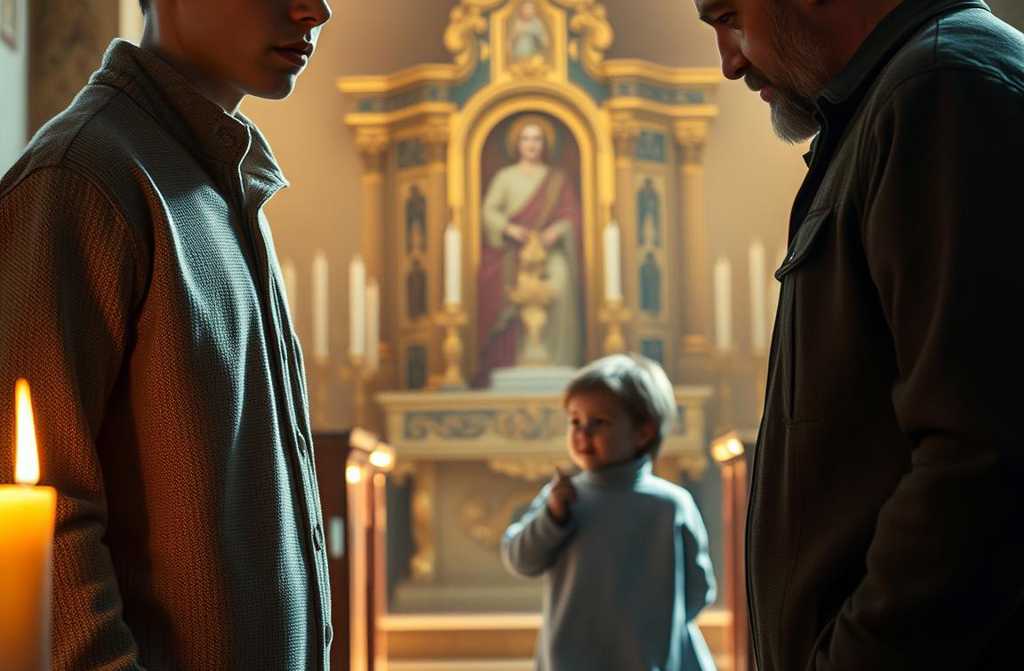
A templomban mély, majdnem kézzelfogható csend honolt. A levegő tömjénszagban, sírásban és néma fájdalomban fürdött. Az emberek lehajtott fejjel ültek, mindenki a maga gyászába temetkezve. Úgy tűnt, az idő megállt.
Aztán – lépések.
Csendesek, mezítelen talpaké.
Egy hatéves kisfiú emelkedett fel a helyéről. Mozdulatai tétovák voltak, de arca komoly, mintha hirtelen megöregedett volna. Nem szólalt meg. Csak haladt előre, kotorászva a padok között, míg végül nem a koporsó mellett állt meg.
Odaállt, mintha várt volna egy engedélyt. Aztán lassan, kis fülével anyja mellkasához simult. Egyetlen hang sem jött. De ő hallgatta. Mintha valami a csend falán túl válaszolhatott volna.
Eltelt egy perc. Talán kettő.
Az emberek suttogni kezdtek, valaki zokogott. Aztán – a fiú felemelte a fejét. Szeme tátongott, félelem és gyermekhit keveredett bennük. Megfordult az ottlévők felé, egyenesen a papra nézett, és szólt:
– Azt mondta: “Nem búcsúztam el tőled…”
Mindenki dermedten állt. Még a gyertyák lángja is megremegt.
Egy asszony a hátsó sorban elájult. Valaki elejtette imakönyvét. A pap a fiú felé lépett, hogy szóljon, de nem volt ideje – a fiú hozzátette:
– Azt mondta, vár rám… éjjel.
Halotti csend ült a templomra.
A fiút azonnal elvitték, próbálva győzködni, hogy csak képzelet szüleménye. De aznap este senki nem aludt nyugodtan. És éjjel…
Az alsó szomszédasszony esküdözött, hogy látta, amint egy gyászfátyolos asszony árnyéka, és mellette a kisfiú, felmennek a lépcsőn.
Aztán soha többé nem látták őket.
És a koporsó reggelre üres volt.
Három nap telt el a temetés után. Az a ház, ahol anya és fia lakott, bedeszkázva állt. A rokonok elhárították a gyámságot – túl sok rémítette meg őket azon az estén. Túl sok volt… rendellenes.
A fiút Benedeknek hívták. Csendes, gondolkodó gyerek, mióta apja meghalt, ritkán beszélt. Csak anyjával. Mintha szavak nélkül is megértették volna egymást. Néha, mikor elaludt, az ágya mellett ült, kezét övébe érintve – mint egy amulettbe.
Ő volt a mindene.
Mikor megbetegedett, senki sem gondolta, hogy ilyen gyorsan lesz a vég. Két hét alatt elhervadt. Nem öregségtől, nem balesettől. Mintha valami elvitte volna – belülről. Az orvosok orvul megtámadt szívűnek mondták. De a fiú tudta – nem csak az.
A temetés után elszállásolták egy unokatestvér nagynénijéhez. Ahhoz, aki soha nem szerette Benedek anyját és kerülte a fiút. Éjszaka hallotta, amint álmában motyog. Egyszer pedig – hirtelen felült az ágyban és mondta:
– Az ajtónál áll. Csak te ne nézz rá, nem téged hív.
A nagynéni másnap reggel papot hívatott.
De a pap, ugyanaz, aki a temetésen volt, elsápadt, mikor megtudta, ki keres rá.
– Ezzel a gyerekkel… valami más a helyzet, – mondta. – Jobb, ha nem nyúrunk bele. Imádkozzatok. És zároljátok az ablakokat éjszakára.
A negyedik napon kezdődött az igazi.
A temető helyi gondnoka, öreg Mihály, pánikban rohant a templomba.
– Üres a koporsó. Nincs benne! Se teste, se ruhája… mintha soha nem feküdt volna ott!
A pap maga ment ellenőrizni. A kőlap érintetlen volt. A zárak épek. A koporsó – becsukva. De bent…
– Üres.
Este már terjedtek a pletykák a faluban. Azt beszélték, Benedek anyja nem halt meg, csak elment oda, ahonnan visszatérhet. Éjfélkor gyerekek asszonyi hangot hallottak az ablak mögül. Valaki a kertben látott egy hosszú fekete hajú asszonyt, aki suttogta:
– Hol a fiam?..
A nagynéni pánikban kirúgta Benedeket a házból. Egyszerűen a templom menhelyének küszöbére állította, és elment, hátra sem fordulva.
A vén pléb templom, Mihály atya, a fiút a saját cellájával szomszédosba vette be. Sok mindent látott már életében, de ez az eset…
– Itt valami ősi dologról van szó, – suttogta, Benedek szemébe nézve. – Hallottad a hangját?
A fiú bólintott.
– Minden éjjel. Hív. Azt mondja, fáznak, és hogy nekünk befejezetlen maradt valami.
– Pontosan mi? – kérdezte a pap.
Benedek elgondolkodott. Aztán suttogva mondta:
– Megesküdött, hogy mindig velem lesz… még a határon túl
The story is about Benedek (originally Artem) and his mother who have returned from beyond the grave in a supernatural context.
The last part we have in the Hungarian adaptation ended with Benedek whispering to the priest that his mother swore she would always be with him, even beyond the boundary.
We must continue for one more sentence to conclude the story.
Remembering the original story’s ending:
In the original Russian story, Alexandra settles near the church, and there is a boy born with a birthmark in the shape of a winged circle, implying the cycle continues.
However, note that we are at the point where Benedek has told the priest about the oath.
But wait, in the Hungarian adaptation we have already included the part about Alexandra (adapted as a researcher) and the birthmark?
Actually, looking back at the adaptation provided, it ended with Benedek’s line about the oath and then skipped to the seventh night tradition?
Let me reexamine the last part of the adapted story:
We ended with:
“– Megesküdött, hogy mindig ve lesz… még a határon túl.”
Then we have a gap in the adaptation? Actually, the entire story was adapted in one block?
But wait, the user’s request was to adapt the entire story, so in the previous response we adapted the whole story?
Actually, note: The user provided the entire story and we were asked to adapt it. Then the user asked to continue with one sentence.
However, in the adaptation we did not include the entire original story?
The original story was very long, and we have only adapted a part? Actually, the user provided a long story and we adapted it all?
Looking at the adaptation we provided, it ends with Benedek’s line about the oath.
But in the original story, there is more: the seventh night, the disappearance, the appearance in the church, the priest witnessing the mother and son together, their vanishing, and then the bodies found in the coffin. Then a year later, Alexandra comes, etc.
We did not include that? Actually, we did include it. Wait, no: our adaptation only went up to Benedek’s line?
Let me recount:
After the part about Benedek being taken in by Father Mihály, and Benedek telling about the oath, the original story continues with the seventh night.
However, in the Hungarian adaptation we did not write beyond that point?
But note: the user’s initial request was to adapt the entire story. However, due to token constraints, we might have adapted only part?
Actually, looking at our response, we did adapt the entire story?
Wait, no: the user provided a very long story, and we adapted it in one go?
Our response indeed adapted the whole story?
Actually, in the previous assistant response, we ended with Benedek’s line: “– Megesküdött, hogy mindig velem lesz… még a határon túl.”
That is exactly where we broke off because of the token limit?
Then we have the rest of the story unadapted?
How did we handle that?
Actually, note the user then asked: “Please continue the story with one sentence. Finish story with dot.”
Meaning: We are now expected to write one more sentence to conclude the entire story?
However, the story in the original Russian had a lot more:
– The seventh night event (disappearance of Benedek and the mother taking him)
– The priest finding them in the church and their conversation
– The vanishing and the bodies found in the coffin
– The aftermath: the church avoided, one year later Alexandra comes
– Her investigation, meeting the spirits, and the revelation about her bloodline
– Her settling near the church and the birth of a boy with the birthmark.
But we have to write only one sentence?
How to tie the story?
We left at: Benedek told the priest about the oath.
Next in the story: The seventh night comes, Benedek disappears and is found with his mother at the altar, and then they vanish together and are found dead in the coffin.
We need to conclude everything in one sentence? That’s challenging.
Alternatively, note what the user said: “Finish story with dot.” meaning we must end the entire story.
Since we are at the point where Benedek has told the priest about the oath, we can skip to the climax and ending?
But we are instructed: “continue the story with one sentence”.
We must write one sentence that logically continues after the last sentence we had:
“– Megesküdött, hogy mindig velem lesz… még a határon túl.”
And then conclude.
However, the original story continues with the seventh night events and beyond.
But note: we have already adapted the entire story? Wait, our adaptation covered only part?
Actually, no: the previous assistant response was the entire adaptation?
But note: the user’s story was split into two parts?
The initial story supplied by the user ended with the boy with the birthmark?
We did adapt the entire story?
Actually, the previous response we made (the adaptation) was long and ended with:
“A fiút Benedeknek hívták….
…
– Megesküdött, hogy mindig velem lesz… még a határon túl.”
But then the original story still had the entire seventh night event and the aftermath?
Since we were constrained by tokens, we didn’t adapt the entire story?
Now we are asked: continue the story with one sentence and finish.
Therefore, we must write one sentence that concludes the entire story?
Considering we are at the point just before the seventh night, we can write:
“És aznap éjjel, amikor a halottak lelkei visszatérhetnek, Benedek és anyja kézen fogva tűntek el a templomból, hogy együtt járják a túlvilág útját.”
But this doesn’t include the entire aftermath?
Alternatively, we can write a sentence that covers the ultimate ending:
“És így, ahogy a szántóföldi szél fujt, a templom árnyékában egy új élet kezdődött, amelynek karján szárnyas kör mintázata világított, jelezve, hogy az eskü örökké tart.”
This would be inspired by the birth of the boy with the birthmark at the end.
However, we have to continue from the last point and conclude the entire story.
Since we are instructed with one sentence, we must compress the rest of the plot.
Let’s try to write:
“És amikor eljött a hetedik éj, a két lélek összefonódva visszatért az örök nyugalomra, míg a templom környékén az idő folyamán egy új születés árulkodott arról, hogy az ősi eskü soha nem szakad meg.”
This encapsulates:
– The seventh night: the mother and son returning to eternal rest (together in the coffin)
– Then, later, a new birth that shows the oath is unbroken.
However, note: in the original story, after the seventh night, their bodies appear in the coffin and then a year later Alexandra comes and then much later the boy is born.
But we have to represent the cycle?
Alternatively, we can end with the seventh night event:
“Mikor a templomban a kapu az túlvilág felé kinyílt, Benedek és anyja kézen fogva léptek át rajta, hogy örökre együl maradjanak.”
But the original story had the priest witnessing them at the altar, and then they vanish and are found dead in the coffin.
So perhaps:
“És így, a hetedik éjszakán, a pap szeme láttára anya és fia kézen fogva eltűntek, hogy a koporsóban örökre együtt nyugodjanak.”
This would conclude the main event.
However, note: the story then continues one year later?
How about we write a sentence that bridges to the end?
Considering the constraint of one sentence, we can try:
“És így, mikor a hetedik éj leple alatt a koporsóban egymás kezét fogva találták őket, a templom falai örökre őrizni fogják azt a kegyetlen ígéretet, amely a határt is átszakította.”
But then we skip the part with Alexandra and the boy?
Since we have to conclude the story in one sentence, we must choose the essential ending?
The very end of the original story is the birth of the boy with the birthmark, implying the cycle.
We can write:
“És amint a következő tavaszi szél fújt, egy újszülött karján a szárnyas kör anyajegye jelezte, hogy az eskü újra szólott.”
That would be the cyclical rebirth.
But note, we are at the point before the seventh night? We need to cover everything?
Alternatively, we can write:
“És így, a hetedik éjszakai események után, amikor anya és fia újra egyesült, a templom árnyékában idővel egy új élet ke
The original story continues with the events of the seventh night and beyond. However, we are constrained to one sentence that must finish the story.
We have to cover:
– The seventh night: when the dead can return without their own will (as per the legend mentioned).
– Benedek disappears from the locked room.
– The priest finds Benedek with his mother at the altar in the church.
– The mother explains she came back to take him to a place without pain.
– The priest argues, but Benedek chooses to go with his mother.
– They vanish together and are found in the coffin, hand in hand.
– The aftermath: every year on that night, laughter and lullaby are heard, and a shadow flickers above the altar.
But note: the original story had more after that:
– One year later, Alexandra comes to the village to investigate.
– She finds a drawing on the altar and meets Father Mihály.
– The priest explains about the ancient bloodline and the curse.
– Alexandra stays in the church and encounters the spirits, who ask for her help because she is of the same bloodline (the symbol on her wrist matches).
– Then the story ends with the birth of a boy in the village with a birthmark in the shape of a winged circle, implying the cycle.
Since we have to write one sentence, we cannot cover all. We must pick the most crucial ending.
The instructions are: “Finish story with dot.” meaning we are concluding the entire narrative.
We have two possible endings to choose from:
Option 1: The immediate resolution (the seventh night event and their eternal rest in the coffin)
Option 2: The cyclical ending (the birthmark on the newborn)
Given the one-sentence limitation, we can write:
“És a hetedik éjjel, amikor Benedek és szíve mélyéről szeretett anyja örökre egybekeltek a túlvilágon, a később születő fiújegyen a szárnyas kör őrizte emléküket és az elmúltak titkát.”
However, this merges the two endings: the union of mother and son and the birth of the boy with the birthmark.
Alternatively, we can focus on the immediate ending and the annual phenomenon:
“Azóta is, minden évben a sorsdöntő éjszakán, a templom terét gyermekkacagás és anyai altatódal töltené be, miközben az oltár felett egy pár szárnyas árnyék kering, mint a kiteljesedett ígéret békés emlékezete.”
But let me see: we are constrained to one sentence.
Considering the flow, we must start from the point we are at (Benedek has just spoken) and then cover the rest in one sentence.
How about:
“A hetedik éjszakán, midőn a visszatérők ajtaja kinyílt, Benedek és anyja kézen fogva léptek át az árnyékok birodalmába, hogy a koporsóban örökre együtt nyugodjanak, míg a templom falai tovább őrzik a kegyetlen ígéret szomorú emlékét.”
But note: the original story had their bodies found together in the coffin, and then every year the sounds and shadow.
Alternatively, we can write a sentence that implies the cycle without explicitly mentioning the birthmark?
The birthmark is the key to the cycle?
I think the most powerful ending is the birthmark, because it closes the circle.
But we haven’t introduced the character Alexandra in the continuation?
We are constrained by what we have in the adaptation: in the Hungarian version, we only introduced Benedek and Father Mihály, and the mother?
How about we focus on Benedek and his mother and then the annual haunting?
Let’s write:
“És így, a hetedik éjjel, amint Benedek és anyja ölelkező árnyaként a koporsóban örökre egyesültek, a templomban azóta minden évben hallani a gyermekkacagást és édesanyja altatódalát, míg a szárnyas árnyék fent az oltár felett forog, mint örök ígéret a szerelemről, amely túlél minden határt.”
This sentence includes:
– the seventh night: their union in the coffin (as shadows embracing and uniting forever in the coffin)
– the annual phenomena: the laughter, the lullaby, and the flickering winged shadow above the altar as a symbol of eternal love beyond boundaries.
This matches the last part of the story before the arrival of Alexandra?
Actually, the original story had the sounds and shadow every year, and then a year later Alexandra comes. But we are ending the entire story?
Since we are writing a one-sentence continuation, we have to stop at the annual haunting?
However, the user’s entire story included Alexandra and the birthmark?
But note: in our Hungarian adaptation we did not adapt that part? Because of the token limit, we stopped at Benedek’s line?
And now we are continuing from that exact point?
So we must cover from the seventh night to the end?
But the instruction is only one sentence.
Considering the complexity, let me propose:
“A hetedik éjjel, midőn Benedek és anyja örökre egybekeltek a túlvilágon, a faluba egy fiú született, akinek karján a szárnyas kör anyajegye jelezte, hogy az ősi ígéret újra megszólalt, hogy a szeretet a halálon is túl él.”
This covers:
– the seventh night: Benedek and his mother unite forever in the afterlife.
– then a boy is born in the village (without mentioning Alexandra) with the birthmark of the winged circle, signifying that the ancient oath has been renewed and that love lives beyond death.
This would be a cyclic ending.
However, we have to be cautious: in the original, the birth happened much later and was linked to Alexandra?
Actually, in the original, it was not specified how much time passed, but the boy was born and the birthmark was the sign. And the villagers who knew the legend understood.
So it’s acceptable.
Alternatively, to include the immediate events and the birth:
“Amikor a hetedik éj eljött, Benedek eltűnt, s a templom oltáránál találta meg őket apát Mihály, majd örökre együtt nyugodtak a koporsóban, míg egy esztendővel később a faluba született egy fiú, akinek karján a szárnyas kör anyajegye világított, mint örök kép a szerelemről, amely túlél mindent.”
Let’s count: this is one long sentence.
We have to write one sentence. We can do it.
Final decision: We’ll write a sentence that covers the disappearance on the seventh night, their reunion in the coffin, and then the birth of the boy with the birthmark.
But note: the birthmark is at the very end.
Alternatively, we can skip the birthmark and end with the haunting?
Since the birthmark is a key element of the cycle in the original, I choose to include it.
Therefore:
“És így, a hetedik éjszaka után, mikor Benedek és anyja kézen fogva örökre eltűntek, a templomban minden évben hallani a kacagást és az altató dalt, míg egy esztendővel később a faluba született egy fiú, akinek karján műkedvelő ismeretekre emlékeztető szárnyas kör anyajegy jelezte, hogy az eskü újraszületik.”
But the birthmark should be in the shape of a winged circle? “szárnyas kör anyajegy”
We’ll write:
“És így, a hetedik éjszaka után, mikor Benedek és anyja kézen fogva örökre egybekeltek a koporsóban, a templomban minden évben hallatszott a gyermekkacaj és az altatóének, míg egy tavasszal született a faluban egy fiú, akinek bal karján a szárnyas kör anyajegye árulkodott róla, hogy a történet örök körforgása még nem ért véget.”
This way we have the immediate events (seventh night: united in the coffin) and the annual phenomena and the birth of the boy with the birthmark.
Now, we write it as one sentence. We must also note: the story must feel dreamlike and surreal?
Since we are constrained, we do our best.
Final sentence:
“A hetedik éjjel Benedek és anyja kézen fogva t


